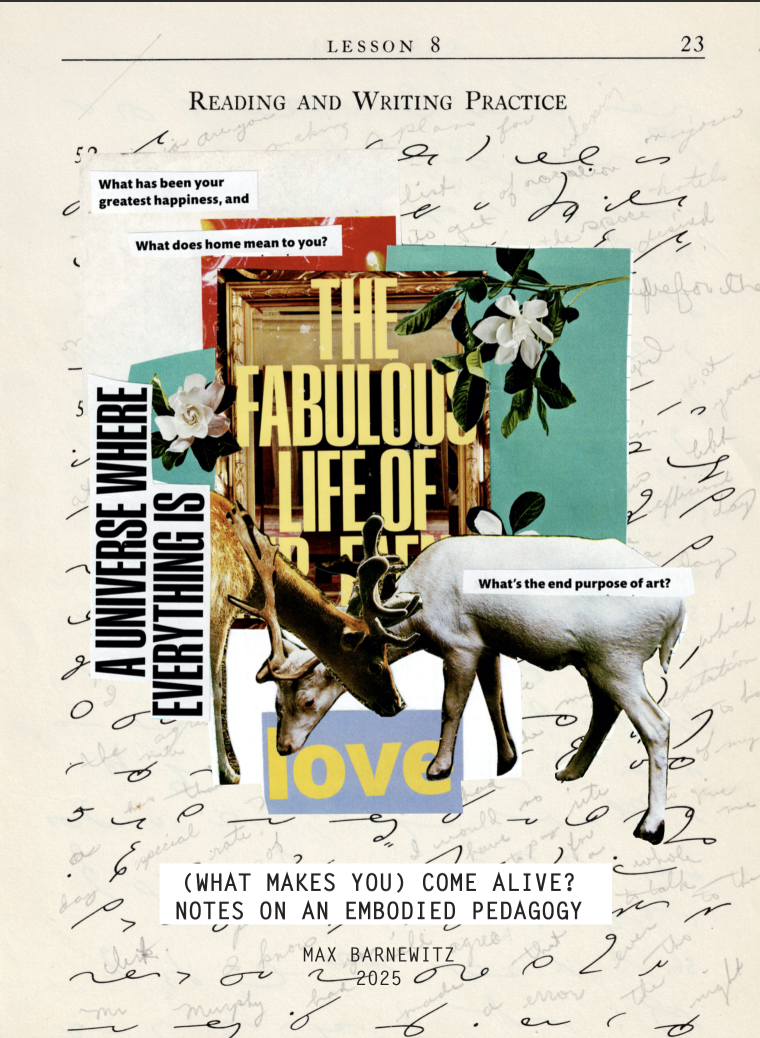
(What Makes You) Come Alive?
Notes on an Embodied Pedagogy
DOI:
https://doi.org/10.12794/journals.ujds.v4i1.331Abstract
At the end of the Fall 2024 semester, I asked my class of freshmen honors students to answer in zine form “What Makes You Come Alive?” The question draws from philosopher Howard Thurman’s urgent message and Corita Kent’s vibrant call to action, “Come Alive” (1967). The fill-in-the-blank zine asks students to engage their inner Sendakian “wild things” and playfully answer to their deepest, wildest desires. The honors STEM majors were alarmed by the pathos of the task, but came away with shared empathy and increased connection with their peers. Zines have been a staple in my classrooms for their ability to engage embodied creativity and transform communities that honor diverse experiences. In my illustration courses, after a day each semester spent deconstructing AI generated images, we retreat to the library’s zine archive, pour over the fragile, hand-made works, and then sit and make our own zines, relishing the ragged edges and scratchy writing that could never be born of AI. As a trans arts scholar deeply invested in diversity and equity, my current scholarship is devoted to activating zines – in college level courses, youth summer camps, and circles of queer adult organizers – to help engage the classroom as an assemblage that resists fascist infrastructure, AI, and institutional censorship. This zine expands on four themes – fear, embodiment, play, and work – to harness the possibilities of zines in the classroom and build brave and embodied communities for shared empathy and powerful self-expression.
References
Published
Issue
Section
License
Copyright (c) 2026 Max Barnewitz

This work is licensed under a Creative Commons Attribution-NonCommercial 4.0 International License.
- Unless otherwise specified by the author/s (because the work contains components to which the author/s do not hold copyright, e.g. licensed music/artwork), works are published using the Creative Commons Attribution-NonCommercial (CC BY-NC) license. Authors may also elect to license their works under more permissive terms at their discretion.
- Authors retain copyright and publishing rights of their work without restriction. We ask as a courtesy that republished works acknowledge Unbound as a previous venue of publication.
 This journal is hosted by the