Zines are Inevitable!
DOI:
https://doi.org/10.12794/journals.ujds.v4i1.339Abstract
Much attention has been paid to the effects of generative AI on education, with growing worries centered on the evidence of students who are using LLMs to cheat on their coursework. However, we argue that the proliferation of AI-use among students has only exacerbated what the American educational system has long been cheating students out of: the guided development of their human creativity. It’s little wonder that living within a system and culture that demands rapid productivity and passive recitation of received knowledge has created students who view AI as a means of streamlining a workload that appears both perfunctory and meaningless. We advocate for a renewed pedagogical focus on students’ creative expression.
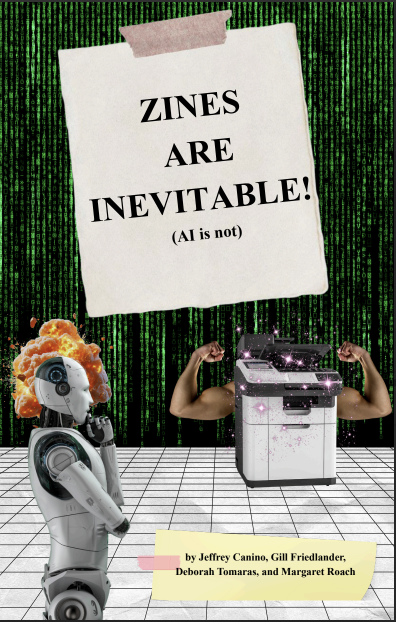
The inherently social nature of zines makes them ideal for promoting connection and creativity in the classroom. We highlight some possible components of zine projects that, even if not explicitly presented as “anti-AI,” help counter its enervating and dependency-producing effects; instead, they decouple student writing from a focus on grades in favor of curiosity, multimodal communication, and self-expression. We created a digital zine with scrapbooking elements; we have included both a digital reading version, and one that can be printed. This zine contains our arguments, research, and practical suggestions for zine-based assignments.
References
Downloads
Additional Files
Published
Issue
Section
License
Copyright (c) 2026 Jeffrey Canino, Gillian Friedlander, Deborah Tomaras, Margaret Roach

This work is licensed under a Creative Commons Attribution-NonCommercial-ShareAlike 4.0 International License.
- Unless otherwise specified by the author/s (because the work contains components to which the author/s do not hold copyright, e.g. licensed music/artwork), works are published using the Creative Commons Attribution-NonCommercial (CC BY-NC) license. Authors may also elect to license their works under more permissive terms at their discretion.
- Authors retain copyright and publishing rights of their work without restriction. We ask as a courtesy that republished works acknowledge Unbound as a previous venue of publication.
 This journal is hosted by the