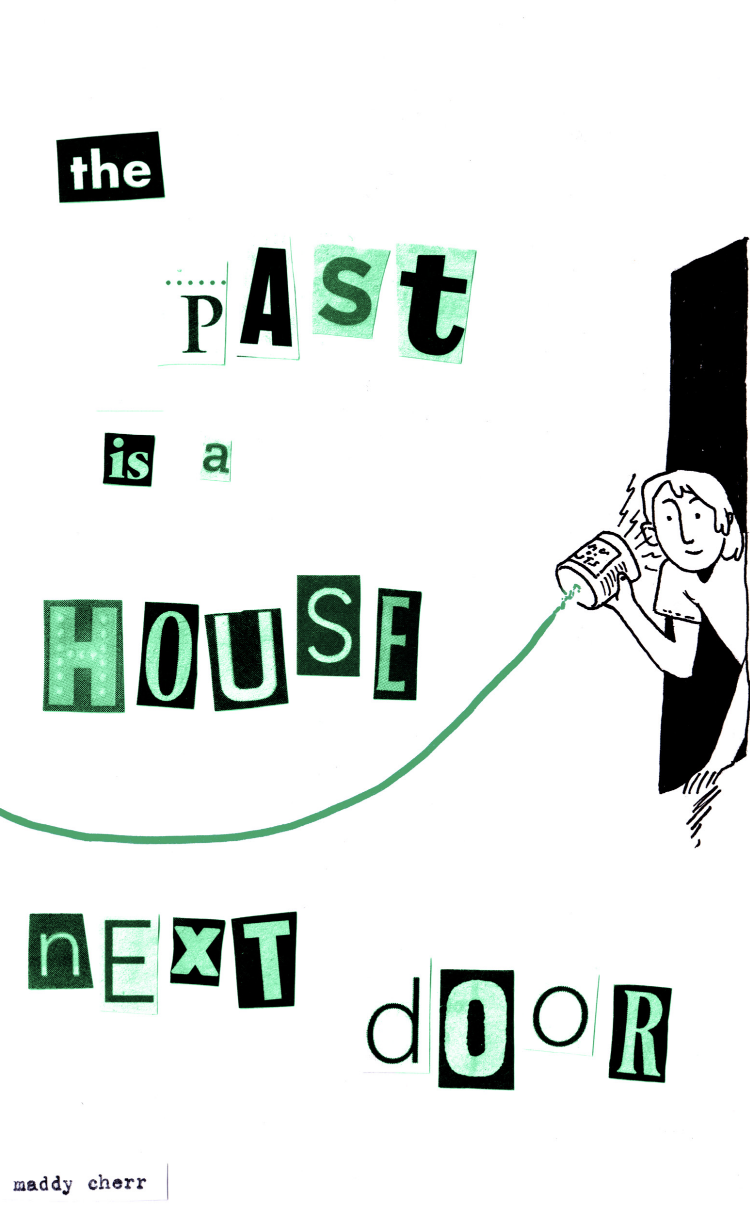
the past is a house next door
DOI:
https://doi.org/10.12794/journals.ujds.v4i1.341Abstract
When we imagine history, we envision it as a distinct schism between ‘then’ and ‘now.’ Yet, the foundational expectations of the zine as a medium (colloquial language, appropriated imagery, anachronism) often disrupt this temporal separation. Because certain groups living on social or political margins have disproportionately embraced the zine format, both creating and following the expectations of the medium, the zine acts as a collapse of the past and present for these groups in particular. Marginalized people often experience a kind of blurred chronological distinction, even outside of the zine format; this is a reflection of the necessity of self-archiving for community safety and remembrance, and is a need reflected in the culture and format of zines.
I’m an illustrator and cartoonist. In this zine, I write and illustrate a visual essay exploring this theme of the zine closing the separation between ‘then’ and ‘now’, citing primarily diaristic zines and perzines but working through a framework presented by Walter Benjamin’s idea of the ‘storyteller.’ Perzines’ often undated, anonymous formatting especially leads to a confusion between past and present — a confusion that can act as a political stance, but also as a personal balm. Ultimately, I argue that perzines are a way to remind one another that we are not alone and our experiences are not unprecedented. It is a disorientation and a relief to know that thirty years ago or yesterday, a writer with no identification but a hotmail email address and a wonky self portrait had the same political fights you do, the same elations and anxieties. Zines exist as a reminder that the past is not a foreign country, but the house just next door.
References
Downloads
Additional Files
Published
Issue
Section
License
Copyright (c) 2026 Maddy Cherr

This work is licensed under a Creative Commons Attribution-NonCommercial 4.0 International License.
- Unless otherwise specified by the author/s (because the work contains components to which the author/s do not hold copyright, e.g. licensed music/artwork), works are published using the Creative Commons Attribution-NonCommercial (CC BY-NC) license. Authors may also elect to license their works under more permissive terms at their discretion.
- Authors retain copyright and publishing rights of their work without restriction. We ask as a courtesy that republished works acknowledge Unbound as a previous venue of publication.
 This journal is hosted by the