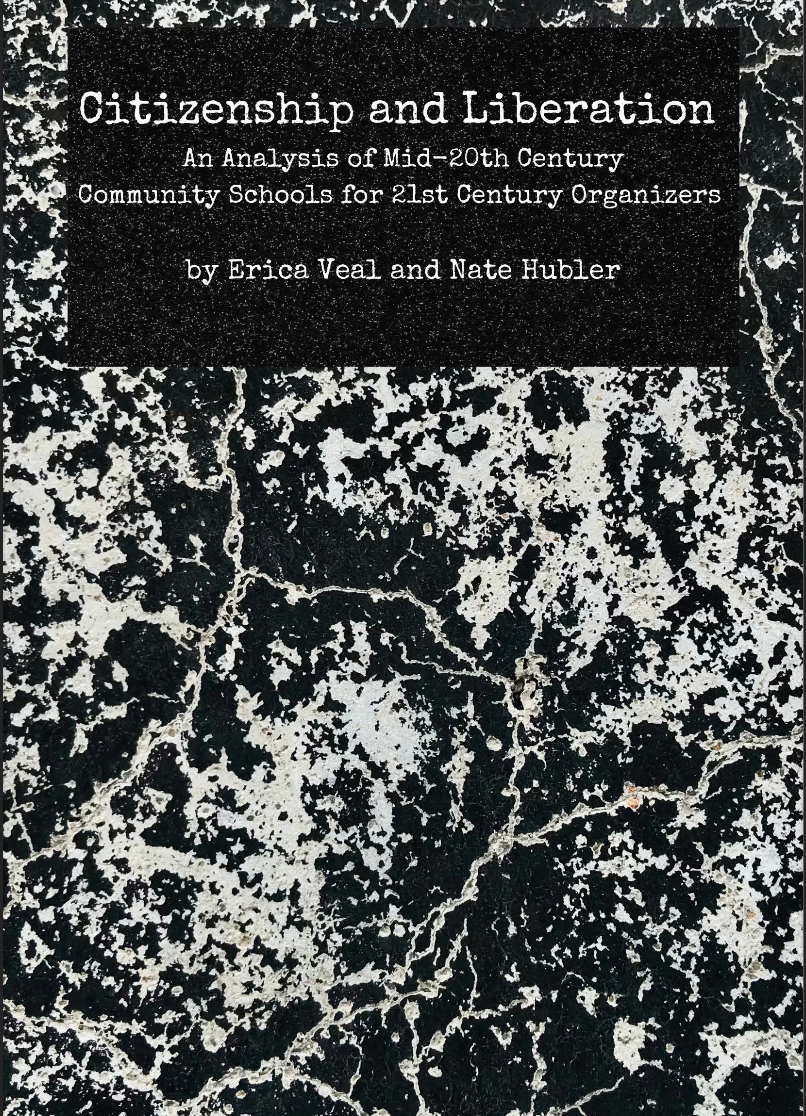
Citizenship and Liberation
An Analysis of Mid-20th Century Community Schools for 21st Century Organizers
DOI:
https://doi.org/10.12794/journals.ujds.v4i1.346Abstract
In the spirit of Mariame Kaba's Archival Activations zine series, “Citizenship and Liberation: An Analysis of Mid-20th Century Community Schools for 21st Century Organizers” analyzes two of the leading adult education programs of the mid twentieth century, the Citizenship School and the Liberation School. The Citizenship School aimed to address the material needs of African American adults in the American South. They improved students’ core handwriting, literacy, and math abilities as well as helped build fundamental skills required to register to vote amidst the racist restrictions of Jim Crow on Black enfranchisement. On the other hand, the Liberation School’s mission to was to teach the lessons of African American history extracted from dominant narratives through a curriculum rooted in the Marxist-Leninist theory of historical materialism. The hope was that the Liberation School would prepare a vanguard of Black organizers to usher in the qualitative and quantitative shifts necessary to radically reorganize society to improve material conditions for all working class people in a way the civil rights era of struggle could not and did not.
Understanding the different ways in which the Citizenship School and Liberation School responded to the material reality of Jim Crow leads to a crucial research question: what can today’s organizers learn from the experiences of two of the leading adult education programs of the mid twentieth century? To explore this crucial question, this academizine explores the archival collections of James E. Campbell, Septima P. Clark, and Bernice Robinson as well as delving into the larger archives and the closed-stack library housed at the College of Charleston’s Avery Research Center for African American History and Culture. This close exploration leads to the identification of key lessons to be gleaned from both models of adult education, specifically as they can be applied to the work of contemporary organizers aiming to create broad societal change in American society. These lessons are positioned within the liberatory cannon of Marxism-Leninism to provide added context and help highlight additional ways for organizers to think about their work in the present political climate with particular emphasis on the importance of incorporating the mass line into organizing work and thinking beyond the limitations of the ballot.
The flexibility of the zine format allows for archives related to the Citizenship School and Liberation School curriculums as well as student and instructor experiences to be reinterpreted to fill gaps in modern popular education and improve understandings of movement work. The format also creates space for primary sources in the archives to become more engaging, accessible, and tell their own stories beyond the bibliography.
References
“Family files new lawsuit over man's death in Al Cannon Detention Center, alleges neglect,” ABC News 4 https://abcnews4.com/news/local/family-files-new-lawsuit-over-mans-death-in-custody-alleges-neglect-james-b-moore-ii-dangelo-brown-sheriff-al-cannon-detention-center-wciv-abc-news-4-01-03-2025 (accessed October 30, 2025).
“How Fannie Lou Hamer Challenged a Nation,” National Museum of African American History and Culture, https://nmaahc.si.edu/explore/stories/how-fannie-lou-hamer-challenged-nation (accessed 28 October 2025).
“James E. Campbell, Curriculum Vitae,” Vertical File Collection; “Campbell, James E.,” Avery Research Center for African American History and Culture, College of Charleston, Charleston, SC, USA.
“Locked Out 2024: Four Million Denied Voting Rights Due to a Felony Conviction,” The Sentencing Project, https://www.sentencingproject.org/reports/locked-out-2024-four-million-denied-voting-rights-due-to-a-felony-conviction/ (accessed October 30, 2025).
“North Charleston police demote, suspend officer who detained teen selling Palmetto roses,” The Post and Courier https://www.postandcourier.com/news/crime/north-charleston-police-demote-officer-palmetto-roses/article_37d42ede-46dd-4e9d-8932-631664413a43.html (accessed October 30, 2025).
“Not Just a Black Thing: An Asian American’s Bond with Malcolm X,” NPR https://www.npr.org/sections/codeswitch/2013/08/19/209258986/the-japanese-american-internee-who-met-malcolm-x (accessed 28 October 2025).
“Social Studies: Afro American Roots” Banks Street College of Education, Vertical File Collection, “Campbell, James E.,” Avery Research Center for African American History and Culture, College of Charleston, Charleston, SC, USA.
“Some Points on the Mass Line,” Freedom Road Socialist Organization https://frso.org/main-documents/some-points-on-the-mass-line (Accessed November 9, 2025).
“The State of Racial Disparities in Charleston County, South Carolina 2000-2015,” Avery Research Center for African American History and Culture (College of Charleston, 2017).
“Walter Scott family marks a decade since fatal North Charleston police shooting,” Live 5 News https://www.live5news.com/2025/04/04/walter-scott-family-marks-decade-since-fatal-north-charleston-police-shooting/ (accessed October 30, 2025).
Adam Fairclough, Teaching Equality: Black Schools in the Age of Jim Crow, (Athens: The University of Georgia Press, 2001).
Aimee Isgrig Horton, The Highlander Folk School: A History of Its Major Programs, 1932-1961 (Carson Publishing Inc., 1989), 42.
Aleksei Leontiev, Political Economy: A Beginner’s Course (Co-operative Publishing Society of Foreign Workers in the U.S.S.R., 1935).
Bernice Robinson, "Text of talk about the Citizenship Training Schools,” (1979), Bernice Robinson papers, Box 3 Folder 8, Avery Research Center for African American History and Culture, College of Charleston, Charleston, SC, USA.
Bernice Robinson, Letter to Myles Horton (June 25, 1961), Bernice Robinson papers, Box 3, Folder 1, Avery Research Center for African American History and Culture, College of Charleston, Charleston, SC, USA.
Bernice Robinson, Untitled typescript (Undated), Bernice Robinson papers, Box 3, Folder 8, Avery Research Center for African American History and Culture, College of Charleston, Charleston, SC, USA.
Elaine Weiss, Spell Freedom: The Underground Movement that Build the Civil Rights Movement (One Signal Publishers/Atria Books, 2025).
Ella Little-Collins, “OAAU Fundraising Letter, “Organization of Afro-American Unity (OAAU) collection, Sc MG 752, Schomburg Center for Research in Black Culture, Manuscripts, Archives and Rare Books Division, The New York Public Library.
Elliot Wigginton, Refuse to Stand Silently By: An Oral History of Grass Roots Social Activism in American, 1921-1964 (Double Day, 1991).
Erica Nicole Veal, “Charleston’s Own Black Shining Prince: James Campbell and the Evolution of African American Education,” (Master’s thesis, College of Charleston and the Citadel, 2013); ProQuest (1554812).
Freedom Road Socialist Organization, “The Political Program of the Freedom Road Socialist Organization,” https://frso.org/wp-content/uploads/2022/08/frso-program.pdf (accessed 23 October 2025).
Friedrich Engels, Introduction to Wage Labour and Capital, Neue Rheinische Zeitung, April 5-8 and 11, 1849 https://www.marxists.org/archive/marx/works/1847/wage-labour/intro.htm (accessed 23 October 2025).
Friedrich Engels, Socialism: Utopian or Scientific (Foreign Language Press: Paris, 2020).
Haynes Johnson, The Age of Anxiety: McCarthyism to Terrorism (Orlando: Harcourt, Inc., 2005).
Highlander Folk School,” Schedule for Training Workshop” (1961), Septima P. Clark papers, Box 7, Folder 10, Avery Research Center for African American History and Culture, College of Charleston, Charleston, SC, USA.
James Campbell interview as cited in William Sales, Jr., From Civil Rights to Black Liberation: Malcolm X and the Organization of Afro-American Unity. (Boston: South End Press, 1994).
James Campbell, “Conversations with Our Donors,” (2008) unprocessed collection, Avery Research Center for African American History and Culture, College of Charleston, Charleston, SC, USA.
James Campbell, interview by Deborah Wright, Charleston, SC, December 13, 2008, Avery Research Center Lowcountry oral histories, Box 1, Folder 16, Avery Research Center for African American History and Culture, College of Charleston, Charleston, SC, USA.
James L. Gibson, “Intolerance and Political Repression in the United States: A Half Century After McCarthyism,” American Journal of Political Science, 52, no.1 (2008).
Karl Marx, Capital: A Critique of Political Economy Volume I trans. Ben Fowkes (Penguin Books: New York, 1982).
Karl Marx, Contribution to the Critique of Political Economy (Progress Publishers, Moscow, 1977), https://www.marxists.org/archive/marx/works/1859/critique-pol-economy/preface.htm (accessed 23 October 2025).
Lydia Lum, “Working Outside the System,” Diverse: Issues In Higher Education 22, no. 26 (February 2006).
Malcolm X, February 1965: The Final Speeches Edited by Steve Clark (New York: Pathfinder, 1992).
Mao Tse-Tung, "On Coalition Government,” Selected Works, Vol. III, (Foreign Language Press of People’s Publishing House, 1965).
Mao Tse-Tung, On Contradiction: A philosophical essay on dialectics, directed against dogmatism (International Publishers, New York, 1953).
Organization of Afro-American Unity “A Statement of Basic Aims and Objectives of the Organization of Afro-American Unity,” June 1964, James E. Campbell papers, Box 4, Folder 25, Avery Research Center for African American History and Culture, College of Charleston, Charleston, SC, USA.
Peniel Joseph, Waiting 'til the Midnight Hour (New York: Henry Holt and Company, 2006).
Septima Clark and Bernice Robinson, Letter to Myles Horton (June 19, 1961), Septima P. Clark papers, Box 7, Folder 3, Avery Research Center for African American History and Culture, College of Charleston, Charleston, SC, USA.
Septima P. Clark, “The Vocation of Black Scholarship: Identifying the Enemy,” Undated, Septima P. Clark papers, Box 3, Folder 48, Avery Research Center, College of Charleston, Charleston, SC, USA.
Septima Poinsette Clark, Echo in My Soul (E. P. Dutton & Co. Inc, 1962).
Southern Christian Leadership Conference, “Part III: A Workshop for Volunteer Teachers in the Citizenship Education Program of the Southern Christian Leadership Conference, 1965,” Septima P. Clark papers, Box 8, Folder 4, Avery Research Center of African American History and Culture, College of Charleston, Charleston, SC, USA.
Stokely Carmichael and Charles V. Hamilton, Black Power: The Politics of Liberation in Black America (New York: Vintage Books, 1967).
The SNCC Legacy Project. “Freedom Summer.” SNCC Digital Gateway. https://snccdigital.org/events/freedom-summer/ (accessed December 22, 2025).
Ward Churchill and Jim Vander Wall, The COINTELLPRO Papers: Documents From the FBI’s Secret Wars Against Dissent in the United States (Cambridge: Southend Press,1990).
Yuri Kochiyama’s Liberation School class notes December 12, 1964, James E. Campbell papers, Box 4, Folder 25, Avery Research Center for African American History and Culture, College of Charleston, Charleston, SC, USA.
Yuri Kochiyama’s Liberation School class notes February 21, 1965, James E. Campbell papers, Box 4 Folder 25, Avery Research Center for African American History and Culture, College of Charleston, Charleston, SC, USA.
Yuri Kochiyama’s Liberation School class notes February 6, 1965, James E. Campbell papers, Box 4, Folder 25, Avery Research Center for African American History and Culture, College of Charleston, Charleston, SC, USA.
Yuri Kochiyama’s Liberation School class notes January 16, 1965, James E. Campbell papers, Box 4, Folder 25, Avery Research Center for African American History and Culture, College of Charleston, Charleston, SC, USA.
Yuri Kochiyama’s Liberation School class notes January 30, 1965, James E. Campbell papers, Box 4, Folder 25, Avery Research Center for African American History and Culture, College of Charleston, Charleston, SC, USA.
Yuri Kochiyama’s Liberation School class notes January 9, 1965, James E. Campbell papers, Box 4, Folder 25, Avery Research Center for African American History and Culture, College of Charleston, Charleston, SC, USA.
Downloads
Additional Files
Published
Issue
Section
License
Copyright (c) 2026 Erica Veal, Nate Hubler

This work is licensed under a Creative Commons Attribution-NonCommercial 4.0 International License.
- Unless otherwise specified by the author/s (because the work contains components to which the author/s do not hold copyright, e.g. licensed music/artwork), works are published using the Creative Commons Attribution-NonCommercial (CC BY-NC) license. Authors may also elect to license their works under more permissive terms at their discretion.
- Authors retain copyright and publishing rights of their work without restriction. We ask as a courtesy that republished works acknowledge Unbound as a previous venue of publication.
 This journal is hosted by the