Arranging Life and Death
A Zine About Taxidermy
DOI:
https://doi.org/10.12794/journals.ujds.v4i1.348Abstract
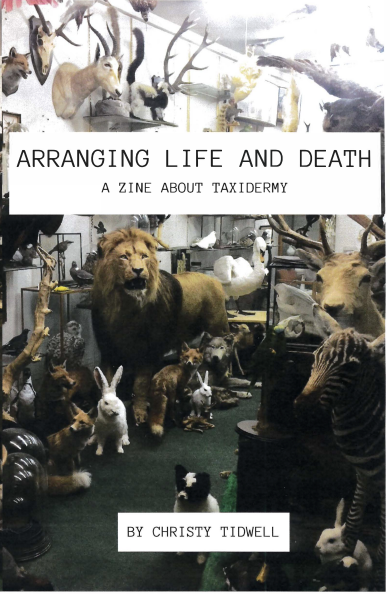
Like zines, taxidermy involves hands-on, material processes of arrangement. This connection between the two forms makes taxidermy a good fit for a zine exploring my research on the topic.
In my zine, I inform the reader about the history and practice of taxidermy and briefly raise some significant questions about taxidermy. For instance, taxidermy is often described as having a kind of agency, able to look back at the audience, but although taxidermied animals’ eyes are striking, they do not actually have this ability. What, then, does the desire to ascribe this kind of agency to taxidermied animals reveal? Taxidermy is also frequently experienced as a uniquely visceral and temptingly tactile method of representing animals. What kind of relationship to the animal (or animal-object) does this allow? Finally, although most taxidermy is intended to be realist, some artists challenge this, moving toward more meta and surreal approaches in what’s called rogue taxidermy or speculative taxidermy. How do these artistic practices and arrangements of the animal complicate ideas about agency and relationships between human/nonhuman?
The zine is a multipage half-letter-sized booklet that combines text about taxidermy and a wide variety of images of taxidermy. It uses pamphlet stitching presented in hard copy, to further connections to taxidermy and its use of stitching, and background images are collages created using old taxidermy manuals. The zine itself is a work of arrangement about a process of arrangement, combining bookbinding, collage, and scholarly research to prompt readers to think more deeply about the ethical ramifications of taxidermy and the arrangement of another creature’s body.
References
Additional Files
Published
Issue
Section
License
Copyright (c) 2026 Christy Tidwell

This work is licensed under a Creative Commons Attribution-NonCommercial 4.0 International License.
- Unless otherwise specified by the author/s (because the work contains components to which the author/s do not hold copyright, e.g. licensed music/artwork), works are published using the Creative Commons Attribution-NonCommercial (CC BY-NC) license. Authors may also elect to license their works under more permissive terms at their discretion.
- Authors retain copyright and publishing rights of their work without restriction. We ask as a courtesy that republished works acknowledge Unbound as a previous venue of publication.
 This journal is hosted by the