
Inflammatory States
Doing Ethnography Where It Hurts
DOI:
https://doi.org/10.12794/journals.ujds.v4i1.350Abstract
This zine chronicles the stakes of ethnographic research at home, both on and under stress in Portland, Oregon, between 2019-2022. During this time, I was improvising an ethnographic study of toxic stress within maternal, fetal and reproductive science but when not following scientists and their work, I found that my daily life, activism, and community activities were just as important to understanding toxic stress as the neatly siloed spaces that I had identified as “fieldsites” within communities of scientific practice. As an ethnographer, I seek “to make the familiar strange and the strange familiar” in how I write stories from my fieldwork. But how does one do this when your field is your home, the world you're describing is toxic– inherently destructive to life, and the stakes of the social relations that hold it together are deeply personal?
Amidst covid-19 lockdowns and racial justice protests, “the field”, for me, became a sort of “sweaty concept” (Ahmed, 2014), with vague boundaries and inadequate language to describe the embodied exposure patterns that underlie social knowledge production. In the vein of the uncomfortable insider (Anderson, 2021) and the vulnerable observer (Behar, 1996), this experiment in ethnographic writing explores the ways the “self” and “the field” become diffuse, non-mutually exclusive facets of anthropological research through a bricolage of interconnected stories relating to emotion, identity, and the narration of ethnography done at home. Anthropologist Chelsey Carter has described research under such conditions as a “homework ethnography” (2019): research in a place where commitments to relational networks and a deep longing for a better future conflicts with models of academic knowledge production.
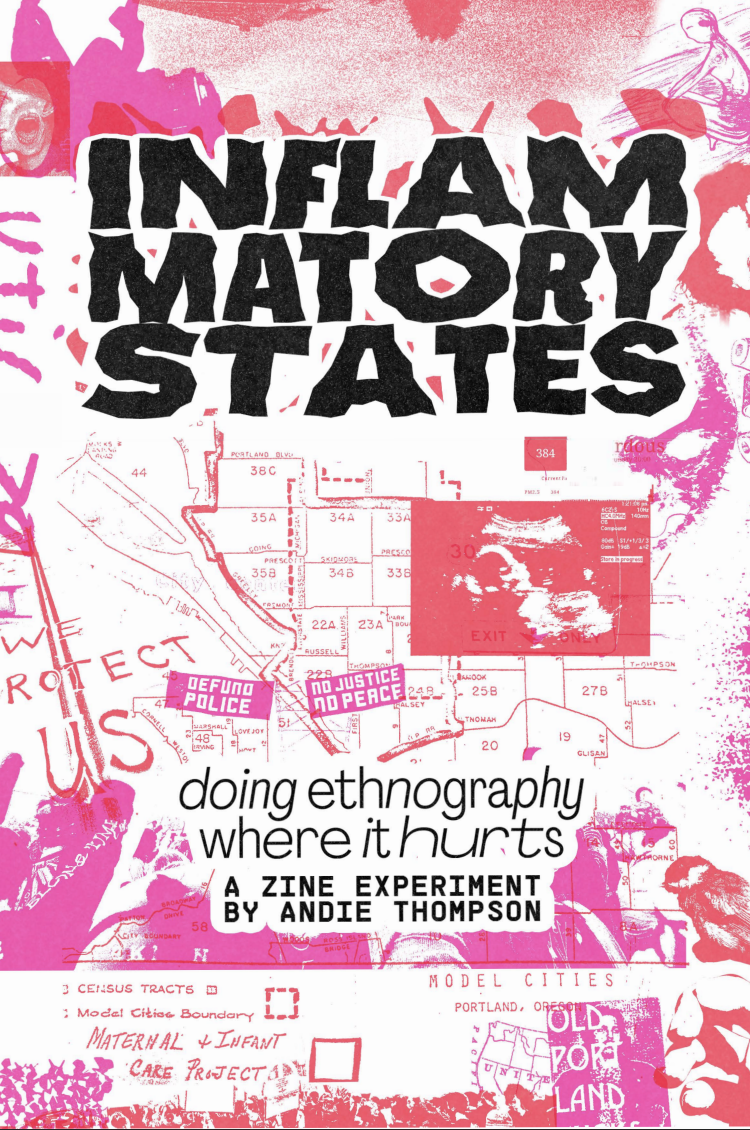
In an effort to find a way to tell ‘homework’ stories and distill down an understanding of the stakes involved as an ethnographer of home, I’ve made this zine, “Inflammatory States: Doing ethnography where it hurts”. The format of the zine allows ethnographic writing to say what matters most to me and the community I come from in Portland, Oregon without pressure to couch it in conversation with academic literature and forcing a coherency between the theory, stories, and method (see Vong, 2016). The zine contains 5 volumes, each taking up a relational interface between “stress” and ethnographic fields, through a visual collage and short essays: stress and the city, stress and the pandemic, stress and the public, stress and the body, and stress and the home.
As a long-form composition, the zine becomes a palimpsest, an intentional reprinting of knowledge through layers of rich connection to perceive a place and time with greater fidelity. As an experiment in ethnographic writing, this zine is a form of “mediated public ethnography” (Vannini & Mosher, 2013), responding to public interests in a format that can be circulated back to the community it describes. For me, this zine became a place to document the rage and love I feel towards the place that I hold as home in my heart and explicitly link the systems responsible for cultivating toxic stress accountable for the harm they do using personal experience, archival and document analysis. For the reader, this zine provides a glimpse into an ethnographic atmosphere, a ‘feeling document’ (see Rowsell and Abrams, 2022) on the toxicity of stress from my perspective and what it takes to do research at home.
References
Published
Issue
Section
License
Copyright (c) 2026 Andie Thompson

This work is licensed under a Creative Commons Attribution-NonCommercial 4.0 International License.
- Unless otherwise specified by the author/s (because the work contains components to which the author/s do not hold copyright, e.g. licensed music/artwork), works are published using the Creative Commons Attribution-NonCommercial (CC BY-NC) license. Authors may also elect to license their works under more permissive terms at their discretion.
- Authors retain copyright and publishing rights of their work without restriction. We ask as a courtesy that republished works acknowledge Unbound as a previous venue of publication.
 This journal is hosted by the