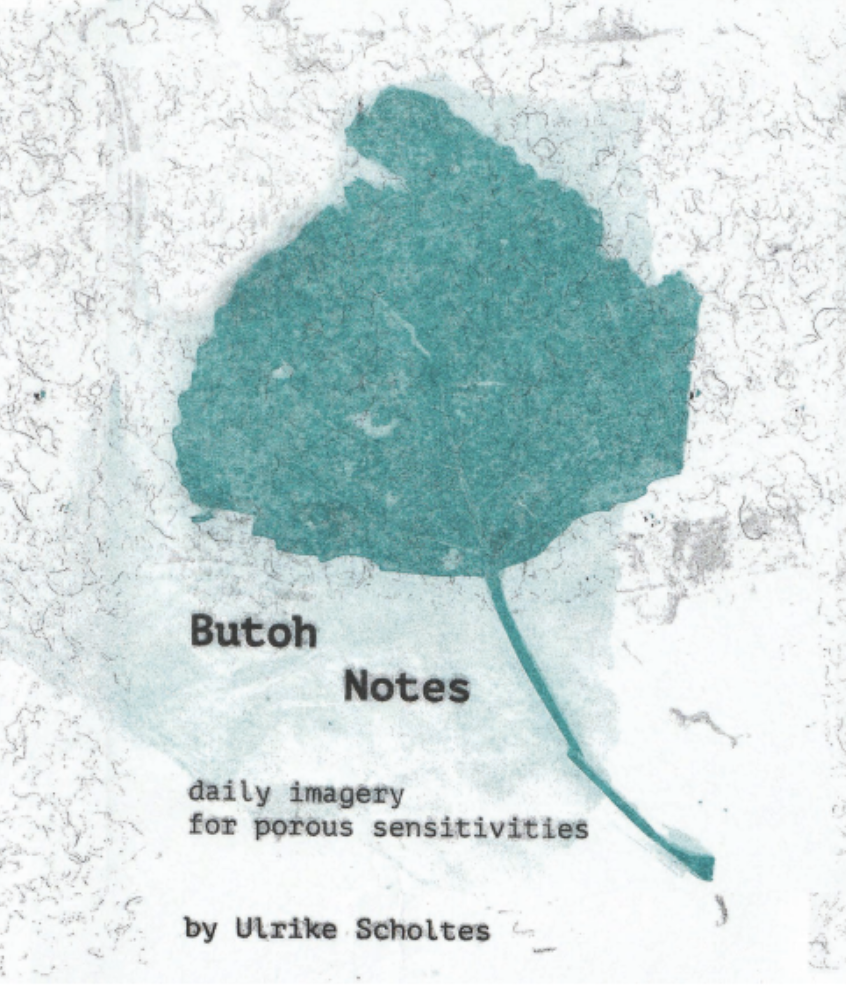
Butoh Notes
Daily Imagery for Porous Sensitivities
DOI:
https://doi.org/10.12794/journals.ujds.v4i1.352Abstract
This collection of mini-zines proposes and performs bodies that are not bounded by the container of the skin. Our current (social) climate requires a conceptualization of an expansive body, such as a “second body” which connects an individual to each and every body on this earth, as proposed by Hildyard (2017). Worlds connect through bodies that are not whole. Scholars have challenged the one-body-one-person rule (Boll & Müller 2020) by presenting bodies and boundaries as leaky, permeable or dissolving (Shildrick 1997, Mol 2002, Hildyard 2017). I bring this conceptualization to bear on who produce knowledge, proposing an imagination of the body of the researcher as porous. But how does such a body feel? These zines are materialized performative imaginations that facilitate blurring boundaries, practicing attunement and feeling connected. Riso-printing allows for an exploration of transparency, layering, the blurring of colours, and a porous materiality (those who touch the original prints, will find traces of the ink on their own body). By disseminating these zines, I am bringing to paper the embodied knowledge of the butoh dance teachers I learned from during my fieldwork on butoh in Japan. My aim is to broaden the repertoire of porous sensitivities of those who read these zines— other researchers and anybody who benefits from practicing a porous body, attunement, or leaking beyond the skin of one’s individual body.
References
Additional Files
- Scholtes, Butoh Notes: Daily Imagery for Porous Sensitivities, Folding instructions
- Scholtes, Butoh Notes: Daily Imagery for Porous Sensitivities, Printable
- Scholtes, Butoh Notes: Daily Imagery for Porous Sensitivities, Digital (Glassdoll)
- Scholtes, Butoh Notes: Daily Imagery for Porous Sensitivities, Digital (Pollen)
Published
Issue
Section
License
Copyright (c) 2026 Ulrike Scholtes

This work is licensed under a Creative Commons Attribution-NonCommercial 4.0 International License.
- Unless otherwise specified by the author/s (because the work contains components to which the author/s do not hold copyright, e.g. licensed music/artwork), works are published using the Creative Commons Attribution-NonCommercial (CC BY-NC) license. Authors may also elect to license their works under more permissive terms at their discretion.
- Authors retain copyright and publishing rights of their work without restriction. We ask as a courtesy that republished works acknowledge Unbound as a previous venue of publication.
 This journal is hosted by the