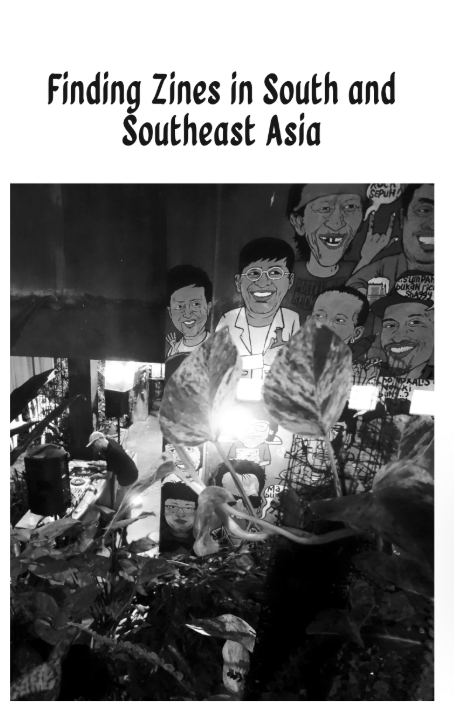
Finding Zines in South and Southeast Asia
DOI:
https://doi.org/10.12794/journals.ujds.v4i1.355Abstract
Asian studies librarians work in a multidisciplinary manner, collecting materials and exercising expertise across domains and genres, ranging from academic research to literature to popular culture. Several university libraries have large zine collections, as they can illuminate points of view outside of the mainstream, including information not created for academic consumption and narratives of people from marginalized identities. For an Asian studies library collection, zines add important linguistic, political, and ethnic diversity—but finding them can be tricky. This zine discusses the author’s process for collecting zines, taking into consideration power and cultural dynamics. Working with communities to collect their publications requires nuance and flexibility. I also discuss how students and researchers might interact with these materials, whether by creating their own zines, building communities online, or through more traditional research methods. Ultimately, this zine illustrates the changing state of Asian studies as a field focused on building and maintaining partnerships across the globe rather than extraction. The ways in which zines are collected for a university library can serve as a through which to view the current state of Asian studies collection practices, including how and why materials are collected and how users near and far can interact with university library collections.
References
Barton, Joshua, and Patrick Olson. “Cite First, Ask Questions Later? Toward an Ethic of Zines and
Zinesters in Libraries and Research.” The Papers of the Bibliographical Society of America 113, no.
2 (2019): 205-216. https://doi.org/10.1086/703341.
Florida, Nancy. “Writing Traditions in Colonial Java: The Question of Islam.” In Cultures of
Scholarship, edited by S. C. Humphreys. The University of Michigan Press, 1997.
Wagner, Ralph D. A History of the Farmington Plan. Scarecrow Press, 2002.
Additional Files
Published
Issue
Section
License
Copyright (c) 2026 Zoë McLaughlin

This work is licensed under a Creative Commons Attribution-NonCommercial-NoDerivatives 4.0 International License.
- Unless otherwise specified by the author/s (because the work contains components to which the author/s do not hold copyright, e.g. licensed music/artwork), works are published using the Creative Commons Attribution-NonCommercial (CC BY-NC) license. Authors may also elect to license their works under more permissive terms at their discretion.
- Authors retain copyright and publishing rights of their work without restriction. We ask as a courtesy that republished works acknowledge Unbound as a previous venue of publication.
 This journal is hosted by the