Disability, Technoethics, and Power
Exploring AI Refusal
DOI:
https://doi.org/10.12794/journals.ujds.v4i1.367Abstract
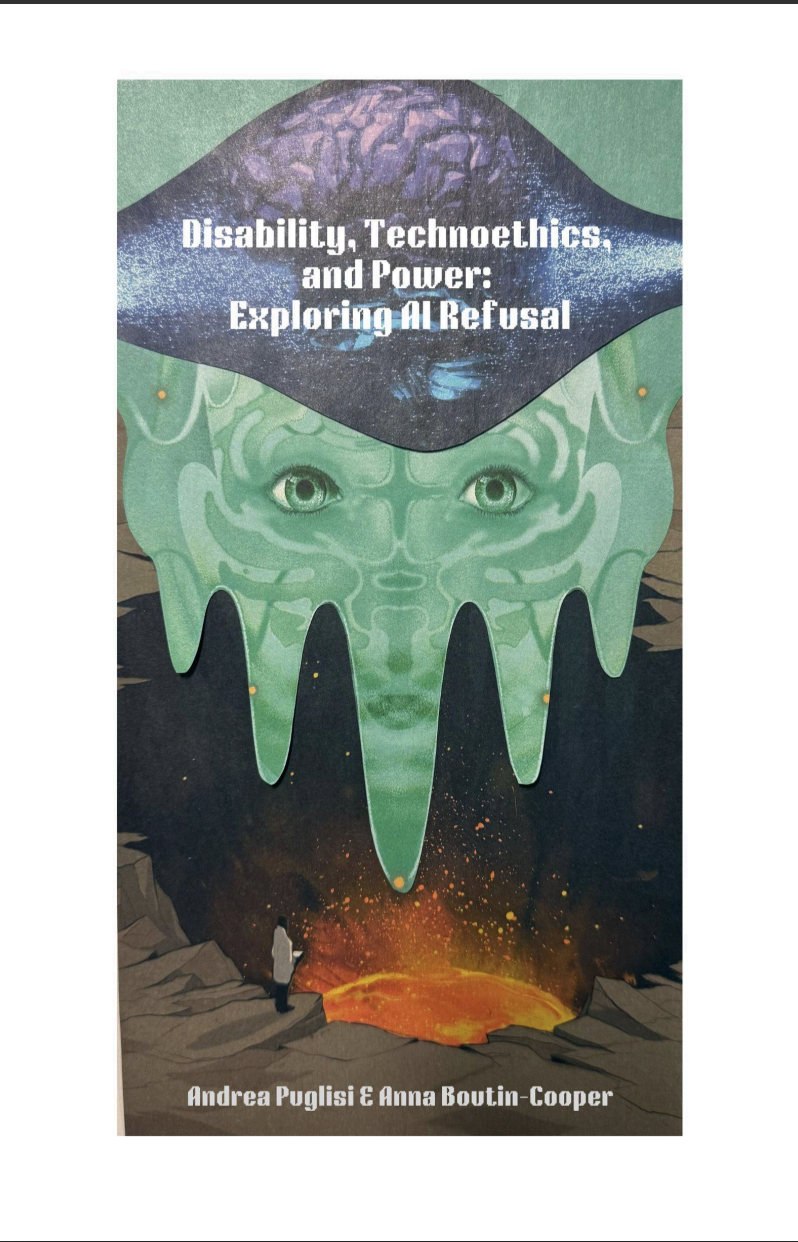
Artificial Intelligence (AI), including generative AI, is marketed and widely discussed as a great benefit to many, especially to disabled and neurodivergent individuals. It appears to level the playing field, so to speak, by making certain tasks and work more accessible, performing the often disproportionately draining mental labor of tasks such as creating outlines, timetables for completing assignments, and more.
While we recognize the potential benefits of solutions to these known challenges, the rapid development and adoption of generative AI largely bypasses meaningful civic input. Decisions about its suitability, design, and impacts are made largely by private and technocratic interests, with little critical engagement from the communities it claims to serve. As a result, the narratives around AI eclipse questions of suitability, and whether the adoption of AI systems and technologies are worth the consequences.
When it comes to technology, including AI, intent matters, but what often matters most are the impacts of decisions. The adoption of any tool or system must be preceded by critical evaluation, assessment, and an understanding of environmental context and consequences. The choice to adopt or reject the use of AI is to be made intentionally, involving a deeper commitment to civic engagement: inclusive, participatory processes that shape not just how AI is used, but also how it is governed.
This zine will explore questions around the intersection of generative AI and disability, examining the ways in which the purported benefits of generative AI are not actually benefitting anyone, disabled or not, through a disability justice lens. Instead, we work together to imagine alternative futures, where AI is not inevitable, and where we can envision a more just, equitable, and radically kind world. Together, we ask our audience if they are willing and prepared to refuse systems of harm.
References
Adams, Jerome. 2025. “The Imperative Link Between Civic Engagement and Public Health: Insights From a Former US Surgeon General.” American Journal of Public Health 115 (3): 313–15.
https://doi.org/10.2105/AJPH.2024.307995
Adams, James Truslow. The Epic of America. Boston: Little, Brown, and Co. Accessed December 29, 2025.
https://archive.org/details/in.ernet.dli.2015.262385/mode/2up
Adoh, E. “Many teens are turning to AI chatbots for friendship and emotional support.” Monitor on Psychology, 56, no. 7 (2025): n.p. https://www.apa.org/monitor/2025/10/technology-youth-friendships
AFL-CIO. Memorandum: Elon Musk’s disregard for worker safety at his companies. April 9, 2025. https://aflcio.org/sites/default/files/2025-04/Memo%20on%20Elon%20Musk%20OSHA%20cases_.pdf
Bender, Emily, and Alex Hanna. The AI Con: How to Fight Big Tech’s Hype and Create the Future We Want. New York: Harper, 2025.
Benjamin, Ruha. Race After Technology: Abolitionist Tools for the New Jim Code. Medford: Polity, 2019.
Berne, Patricia, Aurora Levins Morales, David Langstaff, and Sins Invalid. “Ten Principles of Disability Justice.” Women’s Studies Quarterly, 46, no. 1-2 (2018): 227-230. https://doi.org/10.1353/wsq.2018.0003.
Calvert, Brian. “AI Already Uses as Much Energy as a Small Country. It’s Only the Beginning.” Vox, March 28, 2024. https://www.vox.com/climate/2024/3/28/24111721/climate-ai-tech-energy-demand-rising
Chayka, Kyle. “Techno-Fascism Comes to America. “The New Yorker, February 26, 2025. https://www.newyorker.com/culture/infinite-scroll/techno-fascism-comes-to-america-elon-musk
Cohen, Donald, & Allen Mikaelian. The Privatization of Everything: How the Plunder of Public Goods Transformed America and how we can Fight Back. New York: The New Press, 2021.
Commons Librarian. “Power and Power Mapping.” The Commons: Social Change Library. 2022. https://commonslibrary.org/power-and-power-mapping-start-here/#Power_Mapping
Crawford, Kate, & Vladan Joler. Anatomy of an AI System. Anatomy of an AI System. (2018). http://www.anatomyof.ai
Davis, Nicollette, Mondo Vaden, Marco Seiferle-Valencia, Jess Saldaña, & DeAnn Brame. “The Library is NOT for Everyone (Yet): Disability, Accommodations, and Working in Libraries.” College & Research Libraries News, 85, no. 2 (2024): 58-61. https://doi.org/10.5860/crln.85.2.58
Daub, Adrian. What tech calls thinking: An inquiry into the intellectual bedrock of Silicon Valley. New York: Farrar, Straus and Giroux, 2020.
Dillet, Benoit. “Technofascism and the AI Stage of Late Capitalism.” Blog of the APA, March 10, 2025. https://blog.apaonline.org/2025/03/10/technofascism-and-the-ai-stage-of-late-capitalism/
“Disability Rights vs. Disability Justice.” Disability Justice @ SJSU: A Resource for Faculty. Accessed October 22, 2025. https://blogs.sjsu.edu/disabilityjustice/start-here/disability-rights-vs-disability-justice/
Dupere, Kate. “Researchers Raise Concerns About Overlooked Side Effect of AI Boom: 'Big Tech Exploitation'.” The Cool Down, December 28, 2025. https://www.thecooldown.com/green-business/ai-data-centers-environmental-impact/
Durand, Cédric. “Fragile Leviathan?” NLR/Sidecar, January 30, 2025. https://newleftreview.org/sidecar/posts/fragile-leviathan
Eisenstat, Yaël, & Nils Gilman. “The Myth of Tech Exceptionalism.” Noema, February 10, 2022.
https://www.noemamag.com/the-myth-of-tech-exceptionalism
Fischer, Frank, Gerald Miller, & Mara S. Sidney, eds. 2017. Handbook of public policy analysis: Theory, politics, and methods. 1st ed. New York: Routledge.
Foley, Alan, & Fasika Melese. “Disabling AI: power, exclusion, and disability.” British Journal of Sociology of Education, (2025): 1–22.
https://doi.org/10.1080/01425692.2025.2519482
Fox, Violet B. A Librarian Against AI; or, I Think AI Should Leave. Chicago: Self-published, 2024. https://violetbfox.info/against-ai/
Gasior-Kavishe, Jo. “AI is Infringing on Your Civil Rights. Here’s How We Can Stop That.” American Civil Liberties Union, December 3, 2025. https://www.aclu.org/news/racial-justice/ai-is-infringing-on-your-civil-rights-heres-how-we-can-stop-that
Gebru, Timnit, and Émile P. Torres. 2024. “The TESCREAL Bundle: Eugenics and the Promise of Utopia through Artificial General Intelligence”. First Monday 29 (4). https://doi.org/10.5210/fm.v29i4.13636
González, Roberto J. 2025. “American Technofascism.” Human Organization, November 1-5.
https://doi.org/10.1080/00187259.2025.2585410
Gu, Hongfei. (2023). “Data, Big Tech, and the New Concept of Sovereignty.” Journal of Chinese Political Science, 29 (December 2024): 1-22. https://doi.org/10.1007/s11366-023-09855-1
Hannah-Jones, Nikole, Caitlin Roper, Ilena Silverman, and Jake Silverstein, eds. The 1619 Project: A New Origin Story. New York: One World, 2021.
Hatfield, Jenn. 2025. “The changing face of Congress in 7 charts.” Pew Research Center, March 3, 2025. https://www.pewresearch.org/short-reads/2025/03/03/the-changing-face-of-congress-in-7-charts/
Harris, Benjamin, and Jennifer Brooker. 2025. “Environmental Scanning: A Look to the Future.” New Directions for Evaluation, 2025 (185–186): 33–41. https://doi.org/10.1002/ev.20633
Harvard University Information Technology. “Generative Artificial Intelligence (AI).” Accessed November 17, 2025. https://www.huit.harvard.edu/ai
Hepp, Andreas, Juliane Jarke, and Leif Kramp, eds. 2022. New Perspectives in Critical Data Studies: The Ambivalences of Data Power. Transforming Communications – Studies in Cross-Media Research. Springer Nature.
Herrick, John M., Phyllis J. Day, Iris Carlton-LaNey, Mark Stern, and P. Nelson Reid. 2008. "Social Policy." In Encyclopedia of Social Work, 20th ed.: Oxford University Press.
“Introduction to the Americans with Disabilities Act.” Americans with Disabilities Act. Accessed November 17, 2025. https://www.ada.gov/topics/intro-to-ada/
Jafry, Azeezah & Jessica Vorstermans. “Evolving intersections: AI, disability, and academic integrity in higher education.” New Directions for Teaching & Learning, 2025, no. 182 (2025): 67–80. https://doi.org/10.1002/tl.20629
Kafer, Alison. Feminist, Queer, Crip. Bloomington: Indiana University Press, 2013.
Kang, Cecilia. “From A.I. to Chips, Big Tech Is Getting What It Wants From Trump.” The New York Times, December 28, 2025. https://www.nytimes.com/2025/12/28/technology/tech-trump.html
Kos’myna, Nataliya. “Your Brain on ChatGPT: Accumulation of Cognitive Debt when Using an AI Assistant for Essay Writing Task.” MIT Media Lab, June 10, 2025. https://www.media.mit.edu/publications/your-brain-on-chatgpt/
Krutka, D. G., Heath, M. K., & Willet, K. B. S. (2019). Foregrounding Technoethics: Toward Critical Perspectives in Technology and Teacher Education. Journal of Technology and Teacher Education, 27(4), 555–574. https://doi.org/10.70725/560948mgghtd
Kuznia, Rob, Allison Gordon, and Ed Lavandera. “‘You’re Not Rushing. You’re Just Ready:’ Parents Say ChatGPT Encouraged Son to Kill Himself.” CNN Investigates, November 6, 2025. https://www.cnn.com/2025/11/06/us/openai-chatgpt-suicide-lawsuit-invs-vis
Lu, Jackson G., Peter Jin, & Alexander S. English. “Collectivism Predicts Mask Use During COVID-19.” Proceedings of the National Academy of Sciences, 118, no. 23 (2021): 1-8. https://doi.org/10.1073/pnas.2021793118
Mankoff, Jennifer, Devva Kasnitz, L. Jean Camp, Jonathan Lazar, & Harry Hochheiser “AI Must Be Anti-Ableist and Accessible.” Communications of the ACM, 67, no. 12 (2024): 40–42. https://doi.org/10.1145/3662731
Manwiller, Katelyn Quirin, Amelia Anderson, Heather Crozier, & Samantha Peter. “Hidden Barriers: The Experience of Academic Librarians and Archivists with Invisible Illnesses and/or Disabilities.” College & Research Libraries, 84, no. 5 (2023): 645-677. https://doi.org/10.5860/crl.84.5.645
Marchese, David. 2025. “Curtis Yarvin Says Democracy Is Done. Powerful Conservatives Are Listening.: The Interview.” New York Times. January 18, 2025. https://www.nytimes.com/2025/01/18/magazine/curtis-yarvin-interview.html
Melamed, Jodi. 2015. “Racial Capitalism.” Critical Ethnic Studies 1 (1): 76–85. https://doi.org/10.5749/jcritethnstud.1.1.0076
Mimura, J.A. (2011). Planning for Empire: Reform Bureaucrats and the Japanese Wartime State. Cornell University Press.
Merriam-Webster.com Dictionary, s.v. “power,” accessed December 30, 2025, https://www.merriam-webster.com/dictionary/power
McQuillan, Dan. Resisting AI: An Anti-Fascist Approach to Artificial Intelligence. Bristol, UK: Bristol University Press, 2022.
Moore, Jared, Declan Grabb, William Agnew, Kevin Klyman, Stevie Chancellor, Desmond C. Ong, and Nick Haber. “Expressing Stigma and Inappropriate Responses Prevents LLMs from Safely Replacing Mental Health Providers.” FAccT '25: Proceedings of the 2025 ACM Conference on Fairness, Accountability, and Transparency, (2025): 599-627. https://doi.org/10.1145/3715275.3732039
Newkey-Burden, Chas. “What Trump's tech bros want.” The Week, October 22, 2023. https://theweek.com/tech/what-trumps-tech-bros-want
Obama, Barack. 2014. "The Most Important Title: Citizen." The White House Blog. September 23, 2014. https://obamawhitehouse.archives.gov/blog/2014/09/23/most-important-title-citizen-president-obama-importance-civil-society
Payne, Kate. “An AI Chatbot Pushed a Teen to Kill Himself, a Lawsuit Against its Creator Alleges.” Associated Press, October 25, 2024. https://apnews.com/article/chatbot-ai-lawsuit-suicide-teen-artificial-intelligence-9d48adc572100822fdbc3c90d1456bd0
Pionke, J. J. “The Impact of Disbelief: On Being a Library Employee with a Disability.” Library Trends, 67, no. 3, (2019): 423–435. https://doi.org/10.1353/lib.2019.0004
Roosevelt, Franklin D. 1941. “Annual Message to Congress: The Four Freedoms.” Transcript. National Archives, January 6, 1941. https://www.archives.gov/milestone-documents/president-franklin-roosevelts-annual-message-to-congress#transcript
Schleifer, Theodore. “Elon Musk Consulted Curtis Yarvin, Right-Wing Thinker, on Third Party.” The New York Times, July 9, 2025. https://www.nytimes.com/2025/07/09/us/politics/elon-musk-curtis-yarvin-third-party.html
Schomberg, Jessica. “Disability as Identity.” In Navigating Disability in the Academic Library, edited by Paula Martin & Samantha Peter, 1-15. Association of College and Research Libraries, 2025.
Sins Invalid. Skin, Tooth, and Bone: The Basis of Movement is Our People. San Francisco: Dancers’ Group, n.d.
Tau, Byron. Means of Control: How the Hidden Alliance of Tech and Government Is Creating a New American Surveillance State. New York City: Crown, 2024.
Wells, Sarah. “Exploring the Dangers of AI in Mental Health Care.” Stanford University Human-Centered Artificial Intelligence. Accessed November 17, 2025. https://hai.stanford.edu/news/exploring-the-dangers-of-ai-in-mental-health-care
Wray, Ben. “Sam Altman’s AI Empire Relies on Brutal Labor Exploitation.” Jacobin, July 6, 2025. https://jacobin.com/2025/07/altman-openai-artificial-intelligence-labor-environment-deepseek
Schleifer, Theodore. “Elon Musk Consulted Curtis Yarvin, Right-Wing Thinker, on Third Party.” The New York Times, July 9, 2025. https://www.nytimes.com/2025/07/09/us/politics/elon-musk-curtis-yarvin-third-party.html
Yang, Angela, Laura Jarrett, and Fallon Gallagher. “The Family of Teenager Who Died by Suicide Alleges OpenAI’s ChatGPT is to Blame.” NBC News, August 26, 2025. https://www.nbcnews.com/tech/tech-news/family-teenager-died-suicide-alleges-openais-chatgpt-blame-rcna226147
Yang, Liu. “Technologies as ‘AI Companions’: A call for more inclusive emotional affordance for people with disabilities.” AI & Society, 40, (2025): 6481-6483. https://doi.org/10.1007/s00146-025-02358-y
Additional Files
Published
Issue
Section
License
Copyright (c) 2026 Anna Boutin-Cooper, Andrea Puglisi

This work is licensed under a Creative Commons Attribution-NonCommercial 4.0 International License.
- Unless otherwise specified by the author/s (because the work contains components to which the author/s do not hold copyright, e.g. licensed music/artwork), works are published using the Creative Commons Attribution-NonCommercial (CC BY-NC) license. Authors may also elect to license their works under more permissive terms at their discretion.
- Authors retain copyright and publishing rights of their work without restriction. We ask as a courtesy that republished works acknowledge Unbound as a previous venue of publication.
 This journal is hosted by the