Exploring Zine Making as Critical Dialogue
DOI:
https://doi.org/10.12794/journals.ujds.v4i1.368Abstract
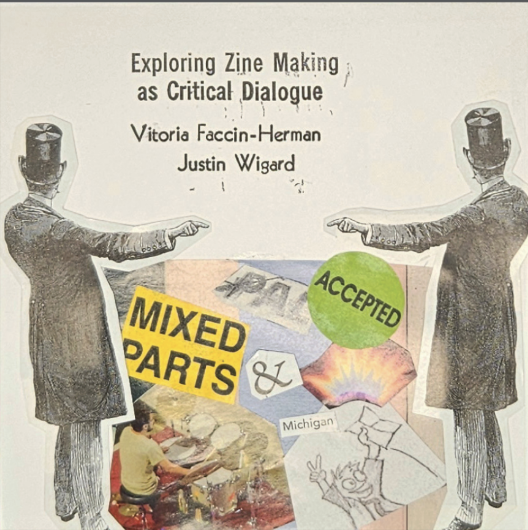
This academic zine was generated through a semester-long weekly dialogue between two assistant professors at the University of North Dakota. Faccin-Herman, Art and Design, considers zines a flexible pedagogical tool that engages mind and body in creating a tangible object. Wigard, English, approaches zines from a comics studies background (literary heritage, visual communication, small press comix) and digital humanities methodology (archiving, circulation, digitization). Rather than a straightforward critical conversation on pedagogy between two colleagues, this endeavor used the zine as a medium to creatively concretize responses, foster interdisciplinary conversations, and capture the experiences of being early career faculty at an R-1, rural university. In other words, the zine is a recording of weekly conversations between Faccin-Herman and Wigard conducted through campus mail, with each educator contributing to the zine in response to each other’s prompts. This can be seen in the accordion-style format of the zine, where each page represents a back-and-forth between the scholars, the form unfolding as the semesterly conversation does. In this way, the scholars not only practice what Ratto and others might term “Critical-Making,” but visually explore their pedagogical practice with and through the zine. Drawing on the work of cartoonists Lynda Barry, Kay Sohini, and Meghan Parker, book creator Esther K. Smith, and scholar Matt Ratto, the project (we hope) demonstrates the vital potential of the zine for academic purposes: as scholarly record, as pedagogical device, as interdisciplinary collaboration.
A coda: Faccin-Herman and Wigard met on their first day at UND, standing in line for coffee and idly striking up a conversation when, quite organically, we discovered we both worked with zines. Yet, despite working a quarter-mile from each other’s offices (literally, separated by the English Coulee), teaching within the same institutional College of Arts & Sciences, and spending a year together in a first-year faculty cohort, Faccin-Herman and Wigard had not previously had an opportunity to discuss pedagogy with one another in depth, let alone how each incorporates zines into curricula. Our responses and conversations are genuine, truly passing back and forth through campus mail. This project encouraged us to connect with our academic specialists and librarians, and we have begun working on an archival collection of regional Midwest zines. This project allowed us to collaborate academically, through a medium we were already familiar with and to learn more about how Visual Arts (Graphic Design) and English (Comics Studies) can come together to break academic traditions.
References
Published
Issue
Section
License
Copyright (c) 2026 Vitoria Faccin-Herman, Justin Wigard

This work is licensed under a Creative Commons Attribution-NonCommercial 4.0 International License.
- Unless otherwise specified by the author/s (because the work contains components to which the author/s do not hold copyright, e.g. licensed music/artwork), works are published using the Creative Commons Attribution-NonCommercial (CC BY-NC) license. Authors may also elect to license their works under more permissive terms at their discretion.
- Authors retain copyright and publishing rights of their work without restriction. We ask as a courtesy that republished works acknowledge Unbound as a previous venue of publication.
 This journal is hosted by the