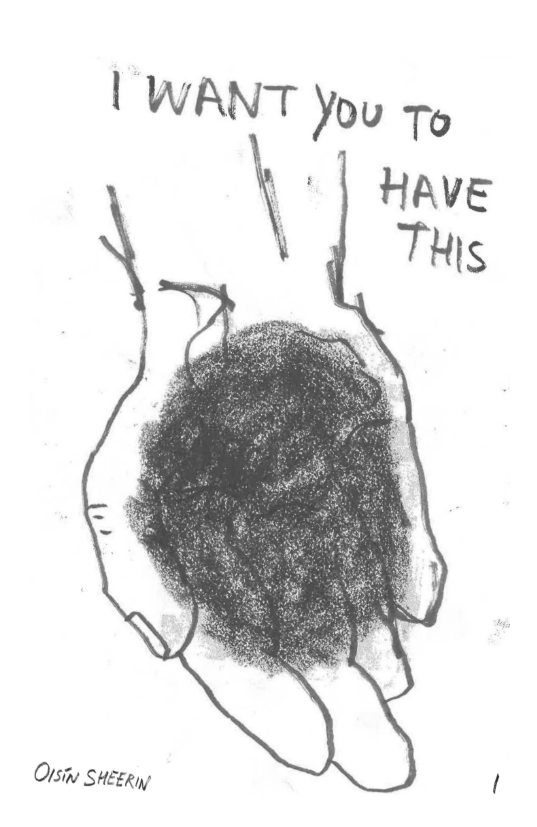
I Want You to Have This
DOI:
https://doi.org/10.12794/journals.ujds.v4i1.395Abstract
What do we owe each other? What can(not) be shared?
Édouard Glissant conceptualizes the poetic as a means to imagine relationality otherwise, beyond extractivism and subjugation (Poetics of Relation). Poetic opacities are intersubjective articulations of what cannot be known of the other, yet must be embraced by an interpersonal generosity to “give-on-with” the other’s unknowable differences (Glissant 142). Despite the gaps between us, we relate to one another through a desire to share our experiences, to give access to our embodied and affective realities. This is not necessarily a desire to be understood, as Glissant shows, understanding can be violent in its reduction. Rather, I view relationality as an affective co-presence, an entangling of separate bodies and their innumerable, ungraspable differences.
I Want You to Have This is my attempt to engage the poetics of our shared relation in all its opacities. I want to give you access to my perspective. I hope that it illuminates (or opacifies) something of your own experience of self, and being-with others. In this zine, I visually and textually explore Glissant’s three entangled concepts of opacity, relationality and poetics through the metaphor of “the angel’s share.” During the maturation of whiskey, a certain percentage of volume is lost through evaporation from the cask; this loss is said to be shared with angels for the returned promise of a quality batch. We are all angels; we share, we take, we try; something is lost, something is gained, yet I don’t know what this thing is.
In short, I want you to have this.
References
Glissant, Édouard. Poetics of Relation. Translated by Betsy Wing. University of Michigan Press, 1997.
Downloads
Additional Files
Published
Issue
Section
License
Copyright (c) 2026 Oisin Sheerin

This work is licensed under a Creative Commons Attribution-NonCommercial 4.0 International License.
- Unless otherwise specified by the author/s (because the work contains components to which the author/s do not hold copyright, e.g. licensed music/artwork), works are published using the Creative Commons Attribution-NonCommercial (CC BY-NC) license. Authors may also elect to license their works under more permissive terms at their discretion.
- Authors retain copyright and publishing rights of their work without restriction. We ask as a courtesy that republished works acknowledge Unbound as a previous venue of publication.
 This journal is hosted by the