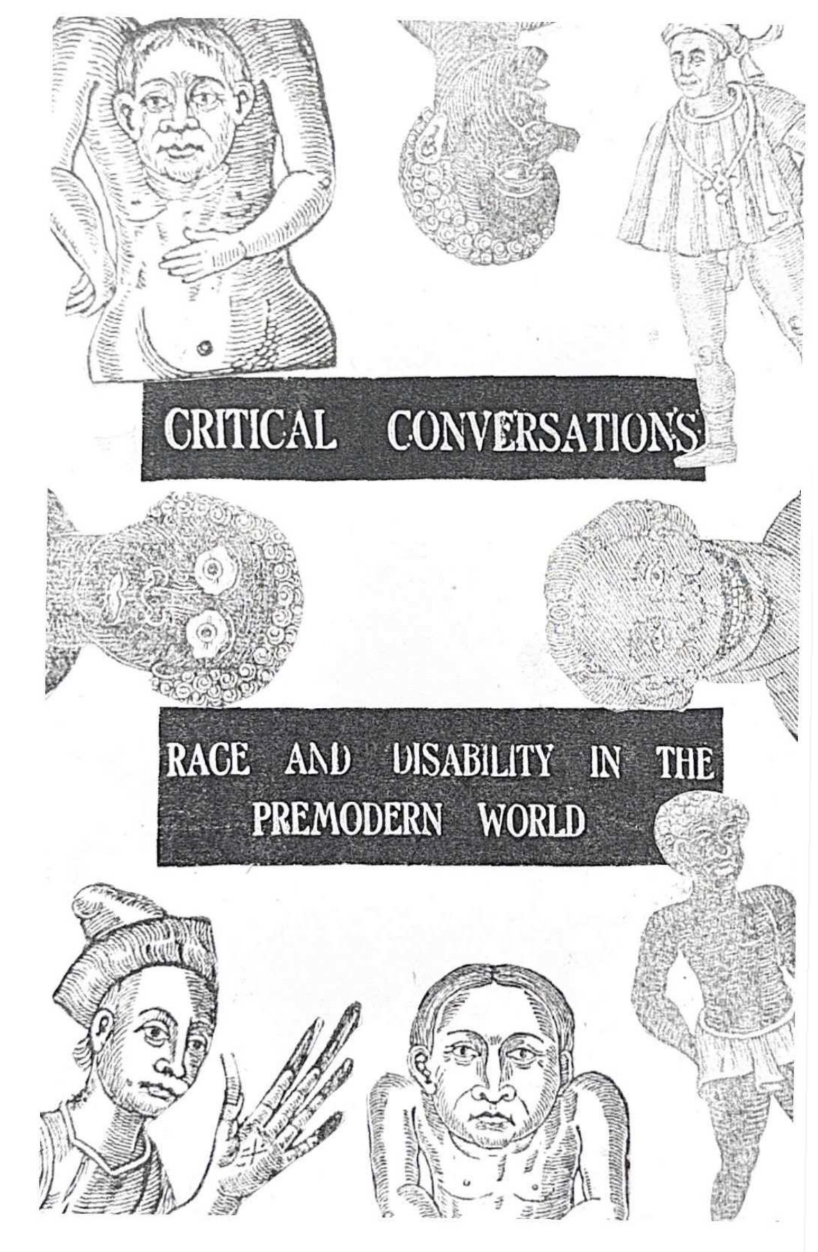
Critical Conversations
Race and Disability in the Premodern World
DOI:
https://doi.org/10.12794/journals.ujds.v4i1.343Abstract
This project emerges from the reading and thinking I have been doing in preparation for my PhD qualifying exams, through which I have focused on connections between premodern critical race and disability studies. Both fields consider conceptions of embodiment, identity, and difference in the early modern period (ca. 1500-1700), but they have historically tended to operate independently, with relatively little collaboration and cross-pollination. My intervention is to join an increasing number of scholars seeking to bring these areas of inquiry to bear on one another, interrogating the ways that race and dis/ability are mutually constituted in premodern drama. By examining performances of bodies that are marked as nonnormative and therefore deviant in some way, I argue, we can begin to track the social and imaginative processes that render certain bodies “ideal” while stigmatizing others.
In pursuing these lines of thought, I of course draw on the work of others before me. Inspired by Sara Ahmed’s writing on the politics and practice of citation, this zine spotlights key texts I have encountered in my research thus far, to honor the work that enables my own. Limited by finite time and resources, these titles are a necessarily incomplete picture of the broad network of intellectual work with which I engage, but I have chosen to include those monographs featured here because they have had especially profound impacts on my thinking. I pair covers of these works with quotes from their acknowledgements sections that nod to the intellectual genealogies within which their work sits. Across the studies represented, each author expresses their awareness of how deeply interconnected our research and writing is in the humanities, despite the popular, romanticized idea of the independent researcher.
I design the zine with two formats in mind: print and digital. While both are generally similar, using a combination of handwritten pages, digital collage, and type handset and printed with a traditional letterpress, there are important distinctions between them. The digital edition is a straightforward presentation of its content, with pages alternating between works from premodern critical race and disability studies. The print edition, though, more fully utilizes the material object of the zine to express the core ideas this project aims to capture. When printed and assembled, the zine makes use of a flutter fold page design to address race and dis/ability on opposite sides of each page. This layout manifests the disjunction between the two fields while creating a circular or looping impression; when fully opened, the zine allows one page to flow simultaneously into its reverse and the next page, bringing all content together. In addition, when fully spread, the pages produce an open space representing the interstices my work is positioned to enter. While individual pages depict standalone texts, the physical zine, which is more than the sum of its parts, reconstitutes discrete sources into a new object that conceptualizes my thinking at this moment in time.
As an intellectual exercise, the creation of this zine has allowed me to better articulate and represent the work I am preparing to do through my dissertation. Drawing on methodologies aligned with research-creation and critical making, the project also offers a model for the ways that creative projects can facilitate rigorous (re)conceptualizations of the scholarship we produce. Emerging from my goal to build out a dissertation with room for interdisciplinarity and critical conversations between richly productive subfields in my area, my zine focuses on the facts of community and cooperation in scholarly work, facts that can be easily elided in our hyper-emphasis on originality. I therefore position this as a dynamic critical-creative project to counter such attachments to intellectual exclusivity and ownership in academic research and writing, foregrounding instead its essentially collaborative, communal nature.
References
Additional Files
Published
Issue
Section
License
Copyright (c) 2026 Dalton Greene

This work is licensed under a Creative Commons Attribution-NonCommercial 4.0 International License.
- Unless otherwise specified by the author/s (because the work contains components to which the author/s do not hold copyright, e.g. licensed music/artwork), works are published using the Creative Commons Attribution-NonCommercial (CC BY-NC) license. Authors may also elect to license their works under more permissive terms at their discretion.
- Authors retain copyright and publishing rights of their work without restriction. We ask as a courtesy that republished works acknowledge Unbound as a previous venue of publication.
 This journal is hosted by the