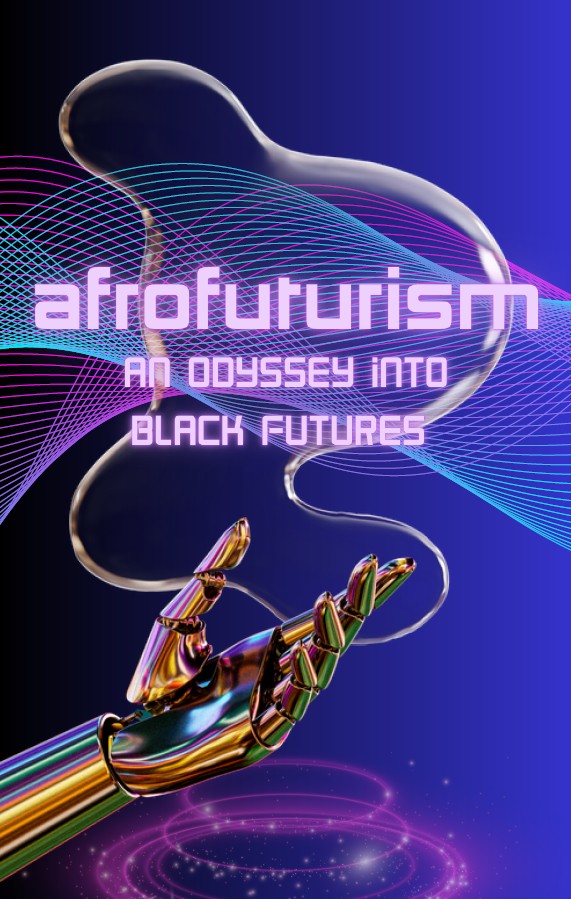
Afro-Futurism
An Odyssey into Black Futures
DOI:
https://doi.org/10.12794/journals.ujds.v4i1.362Abstract
Zines can be used in the library as a method of outreach. They are a non-traditional medium to engage and educate users about library resources and other related topics. In an effort to support zine making as research, pedagogy, and creation at the University of Missouri- Kansas City, the Digital Scholarship Services department in Miller Nichols Library has begun to be the main support of zine creation and dissemination.
This particular zine was made to support a book display on Afro-Futurism for Black History Month in 2026. Afro-Futurism was coined by scholar Mark Dery, and was defined at that time as “African-American signification that appropriates images of technology and a prosthetically enhanced future” (180). Thinking about black futures through the lens of science fiction, history, and liberation, this movement has become a strong creative outlet for artists and scholars of all kinds. Mixed with ideas and aesthetics on astronomy, technology, and traditional African diaspora, Afro-Futurism provides a glimpse into imagined futures for black people through an expanded critical and creative lens.
Functioning as a vehicle for library patrons to learn more about this movement, this zine focuses on resources that patrons can access through library resources. It is not meant to completely encapsulate the genre; it serves as an introduction through cultural touchstones. This zine was created digitally using Canva, using graphics and other openly-licensed images from Wikimedia Commons. Copies were printed and distributed at the book display throughout February 2026.
In addition to this informative resource, the display also included a create-your-own zine station. At this station, patrons practiced making zines and were notified of the other Zine related events happening throughout the library.
References
“Afrofuturism.” n.d. National Museum of African American History and Culture. https://nmaahc.si.edu/explore/exhibitions/afrofuturism.
Art21. 2023. “Nick Cave in "Chicago" - Season 8 | Art21.” YouTube. https://www.youtube.com/watch?v=Hi5vRJWFxkE.
“Black to the future: Interviews with Samuel R. Delany, Greg Tate, and Tricia Rose.” 1994. In Flame Wars: The Discourse of Cyberculture, edited by Mark Dery, 179 - 222. N.p.: Duke University Press. https://doi.org/10.1215/9780822396765.
Bolden, Tony. n.d. “Afrofuturism in Black Music — Timeline of African American Music.” Timeline of African American Music. Accessed February 6, 2026. https://timeline.carnegiehall.org/stories/afrofuturism-in-black-music.
Knowles, Jaharia. 2025. “15 Afrofuturist Artists You Should Know: Sun Ra, Octavia Butler, Rashid Johnson, More.” L'Officiel. https://www.lofficielusa.com/art/afrofuturist-artists-to-know-afrofuturism.
Marral, Rebecca M. 2022. “Octavia E. Butler.” EBSCO Research Starters. https://www.ebsco.com/research-starters/biography/octavia-e-butler.
“Nick Cave.” n.d. Art21. Accessed February 6, 2026. https://art21.org/artist/nick-cave/.
Octavia E. Butler Enterprises. n.d. “Parable Series — Octavia E. Butler.” Octavia Butler. Accessed February 6, 2026. https://www.octaviabutler.com/parableseries.
The Sun Ra Arkestra. n.d. “The Sun Ra Arkestra Official Website.” The Sun Ra Arkestra Official Website. Accessed February 6, 2026. https://www.sunraarkestra.com/1-main.html.
Washington, Angela. 2022. “Afrofuturism in the Stacks.” The Metropolitan Museum of Art. Accessed February 6, 2026. https://www.metmuseum.org/perspectives/library-afrofuturism.
Wilderman, Michael. n.d. “Sun Ra.” National Endowment for the Arts. Accessed February 6, 2026. https://www.arts.gov/honors/jazz/sun-ra.
Additional Files
Published
Issue
Section
License
Copyright (c) 2026 Chayanne Sandoval-Williams, Katie Antrainer

This work is licensed under a Creative Commons Attribution-ShareAlike 4.0 International License.
- Unless otherwise specified by the author/s (because the work contains components to which the author/s do not hold copyright, e.g. licensed music/artwork), works are published using the Creative Commons Attribution-NonCommercial (CC BY-NC) license. Authors may also elect to license their works under more permissive terms at their discretion.
- Authors retain copyright and publishing rights of their work without restriction. We ask as a courtesy that republished works acknowledge Unbound as a previous venue of publication.
 This journal is hosted by the